2026: Week 14 - Focus on Community Organisations
It has been the second week of Easter recess and it’s been a pleasure to spend some time here in Newton Abbot. My focus this week has been on community organisations, and I am proud to say that in this constituency we have an abundance of them.
I was privileged to be invited along to Newton Abbot Rotary club last week, where I spoke to the members about being an MP, from the daily workload, to learning all the intricacies and quirks of the archaic workings of Parliament, to the more mundane things like finding a constituency office!
Rotary is a hugely valuable organisation that does an enormous amount for communities across the UK, with each individual branch running and helping a variety of projects in their local areas. The Newton Abbot branch run a pop up supermarket at discounted rates, and a book bank to ensure that all children have the opportunity to access books; amongst a lot of other things. If you are interested in volunteering to help your community, please do visit their website where you will find details about joining them either as an individual or with a corporate membership.
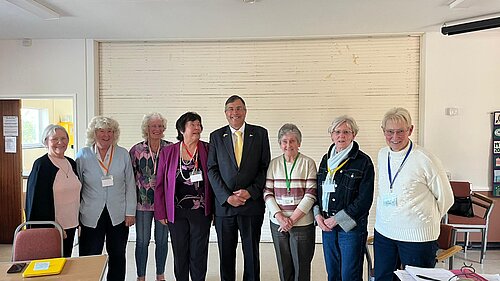
I also attended a meeting of the Cofton Women’s Institute, where I had been asked to give a talk. The women were very engaged and I was able to answer a lot of their locally themed questions after the talk. The Cofton WI is part of the Devon Federation of Women’s Institutes, a fantastic organisation which not only offers its members huge benefits in terms of friendship, wellbeing and staying healthy, but the combined efforts of all the WI groups across Devon do a huge amount for their communities and make a real difference to local lives, along with fantastic cakes!
A few evenings ago I attended a meeting held by Newton Abbot Twinning Association, which was very interesting. I met their new committee and learnt about their ideas to revive their twinning activities with their two twin towns, Besigheim in Germany and Ay-Champagne in France.
It may seem an odd concept these days, having a “twin” town in another country, but we must remember that it was the devastation of war that inspired the first acts of twinning. The earliest twinning arrangement is thought to have been between Keighley in West Yorkshire and Poix-du-Nord in northern France in 1920. After the end of the First World War, soldiers from Keighley who had witnessed the devastation in northern France encouraged their local compatriots to raise funds towards the rebuilding of Poix-du-Nord’s community centre, which was named Keighley Hall in their honour. The arrangement was formalised in 1986 with the exchange of charters.
Twinning then increased in the aftermath of the Second World War, playing a role in promoting reconciliation and reconstruction in western Europe.
Whilst it may feel a little archaic, especially now communication and travel between countries is so easy, remembering why these arrangements came about can go a long way in reminding us that regardless of what country people are from, we have more in common than that which divides us.